Back in the 1980s, I loved the Bloom County newspaper comic strip by Berke Breathed. I like to think of myself as being a fairly attentive youth, but even if I hadn't known who the likes of Jeanne Kirkpatrick were, I would have found them out so I could understand the political references. Those strips are of their time, for sure, but they hold up better than, say, Outland or the Opus strip that Breathed did in later years.
Well, somehow, I forgot all about the Bloom County revival Breathed started on Facebook (well, maybe I ignored it because it was on Facebook) until I saw this collection at the local liberry. Much to my delight, this new incarnation FEELS like Bloom County. It makes some tweaks and adjustments to the characters and the setting, but it doesn't feel forced like earlier attempts to bring it all back did.
It's tempting to make a parallel between the current political climate and events of the 1980s, but I think it's more than that. Breathed alludes to being more comfortable revisiting this world now in his intro, and I think it shows. The result is a lively, funny, relevant collection that recaptures the spirit of the original strip but places it firmly in modern times.
Opus is front and center, but so is Binkley and his anxiety closet. Steve Dallas is more or less the same, as is Bill the Cat. Milo and Oliver return along with Cutter John. It's not just nostalgia that makes the book so enjoyable, though. These comics are funny.
The one thing I dislike about this book is the oddly self-congratulatory tone of it. I am sure Breathed means well by touting his friendship with Harper Lee as one of the reasons he brought back the strip, but it feels kind of weird. Also, many pages feature comments from Facebook originally posted by Bloom County fans. I think maybe a section in the back of the book would have sufficed, but seeing these with some of the actual comics gives an unfortunate "patting ourselves on the back vibe."
I do think Breathed deserves a pat on the back, though, and this collection really surprises me. I thought Bloom was a relic of the 1980s, if a fondly remembered one, and I hadn't been eager to see a revival. Yet it's here, and it belongs.
Showing posts with label Comic strips. Show all posts
Showing posts with label Comic strips. Show all posts
Tuesday, August 29, 2017


Tuesday, June 6, 2017
Journey Into DVD: Charle Brown and Friends
(Editor's Note: 'Mooners Monday will return next week. On Monday.)
This is a single-disc repackaging of material from the Peanuts: 1970s Collection DVD set. It consists of 3 half-hour animated specials originally aired on CBS in the late 1970s along with a featurette.
It's great to see the holiday-themed Peanuts specials every year, but there were tons of other ones on TV back in the day. It's a shame they don't get much play, and it's also a shame that Warner Brothers has released these in confusing subpackages rather than going with affordable comprehensive collections, BUT if you look hard enough, you can find the old stuff and enjoy it today on DVD.
This particular disc reminds you that the Peanuts specials were weird. We sort of chuckle at the quirks of the holiday ones because we've seen them over and over again, but when you revisit some of these lesser-known efforts, you scratch your head sometimes.
The first special is What a Nightmare, Charlie Brown! There may not be too many children's animated specials prominently featuring the word "nightmare," but does it really surprise you that Peanuts would give you one of them?
This is a bizarre half-hour focused on an odd dream Snoopy has. It starts when Charlie Brown, apparently in one of those moods, decides he wants Snoopy to guide him around like a sled dog. When his pet isn't up to the intense physical exertion needed to do that, Chuck berates him and says he's too civilized, etc., etc.
Snoopy often comes off as aloof and not all that likable in the specials, but here Charlie is a real jerk, and it's no wonder his poor dog has a nightmare about actually becoming a sled dog.
Snoop has all kinds of adventures, including working in, performing in, and playing poker in a saloon, before he "goes savage" to become the lead dog in a pack. If you ever wanted to see Snoopy give menacing growls, bare his teeth, and get into a fierce struggle with a "realistic"-looking dog, here's your chance!

The other two specials are more conventional. It's Your First Kiss, Charlie Brown spotlights a football game, and it's refreshing to see a team sport besides baseball. It may be a mistake watching it right after Nightmare, though; after seeing Charlie act like such a tool in that one, I was actually rooting for Lucy to pull the football away from him so he would fall on his duff.
Oh, and how old are these kids? First Kiss delves into the anxiety caused by boys and girls exchanging a smooch, but to do so, it sets up big football games, homecoming courts, and all the things you expect to see from a high school. Actually, even many high school probably don't have the budgets to do all the stuff Charlie's school does in this one.

You're the Greatest, Charlie Brown shows Chuck entering the Junior Olympics, specifically the decathlon, and screwing things up in classic Charlie fashion. Along the way, we see the Masked Marvel, a surprising bit of business from Marcie, and even a Bruce Jenner reference. My favorite line is Peppermint Patty, trying to encourage her pal, calling Charlie "Chucko." His puzzled "Chucko?" response is classic.
Added value comes in the form of the 18-minute featurette You're Groovy, Charlie Brown: A Look at Peanuts in the 70's." No, this is not footage of the Peanuts gang gettin' down to the sweet sounds of fuzz guitar. It's more a general overview of the strip, the production of the specials, and especially creator Charles M. Schulz. It's a nice look at Peanuts, though, and a welcome bonus on the DVD.
These aren't on the level of the perennial holiday favorites we've come to know and love, but they represent a significant portion of the Peanuts legacy and are part of TV history as well. These specials are fun, if a little out there at times, and deserve wider exposure.
This is a single-disc repackaging of material from the Peanuts: 1970s Collection DVD set. It consists of 3 half-hour animated specials originally aired on CBS in the late 1970s along with a featurette.
It's great to see the holiday-themed Peanuts specials every year, but there were tons of other ones on TV back in the day. It's a shame they don't get much play, and it's also a shame that Warner Brothers has released these in confusing subpackages rather than going with affordable comprehensive collections, BUT if you look hard enough, you can find the old stuff and enjoy it today on DVD.
This particular disc reminds you that the Peanuts specials were weird. We sort of chuckle at the quirks of the holiday ones because we've seen them over and over again, but when you revisit some of these lesser-known efforts, you scratch your head sometimes.
The first special is What a Nightmare, Charlie Brown! There may not be too many children's animated specials prominently featuring the word "nightmare," but does it really surprise you that Peanuts would give you one of them?
This is a bizarre half-hour focused on an odd dream Snoopy has. It starts when Charlie Brown, apparently in one of those moods, decides he wants Snoopy to guide him around like a sled dog. When his pet isn't up to the intense physical exertion needed to do that, Chuck berates him and says he's too civilized, etc., etc.
Snoopy often comes off as aloof and not all that likable in the specials, but here Charlie is a real jerk, and it's no wonder his poor dog has a nightmare about actually becoming a sled dog.
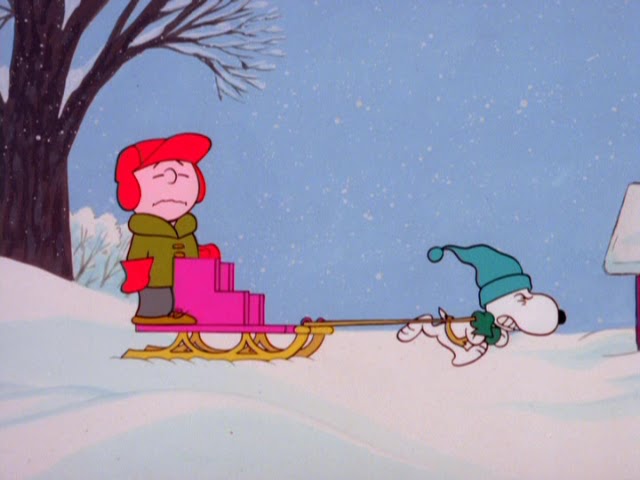 |
| The day Charlie went from proletariat to bourgeoise |
Snoop has all kinds of adventures, including working in, performing in, and playing poker in a saloon, before he "goes savage" to become the lead dog in a pack. If you ever wanted to see Snoopy give menacing growls, bare his teeth, and get into a fierce struggle with a "realistic"-looking dog, here's your chance!

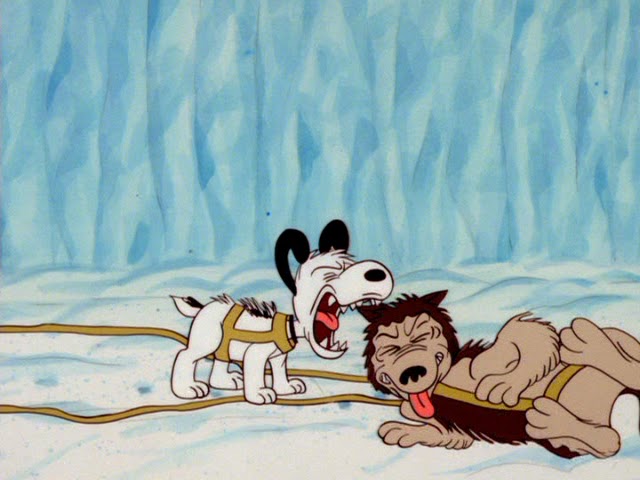 |
| I think *I'm* having nightmares after seeing these images |
The other two specials are more conventional. It's Your First Kiss, Charlie Brown spotlights a football game, and it's refreshing to see a team sport besides baseball. It may be a mistake watching it right after Nightmare, though; after seeing Charlie act like such a tool in that one, I was actually rooting for Lucy to pull the football away from him so he would fall on his duff.
Oh, and how old are these kids? First Kiss delves into the anxiety caused by boys and girls exchanging a smooch, but to do so, it sets up big football games, homecoming courts, and all the things you expect to see from a high school. Actually, even many high school probably don't have the budgets to do all the stuff Charlie's school does in this one.

 |
| You don't see these kinds of parades on Thanksgiving, these days |
You're the Greatest, Charlie Brown shows Chuck entering the Junior Olympics, specifically the decathlon, and screwing things up in classic Charlie fashion. Along the way, we see the Masked Marvel, a surprising bit of business from Marcie, and even a Bruce Jenner reference. My favorite line is Peppermint Patty, trying to encourage her pal, calling Charlie "Chucko." His puzzled "Chucko?" response is classic.
 |
| Why, Marcie! |
Added value comes in the form of the 18-minute featurette You're Groovy, Charlie Brown: A Look at Peanuts in the 70's." No, this is not footage of the Peanuts gang gettin' down to the sweet sounds of fuzz guitar. It's more a general overview of the strip, the production of the specials, and especially creator Charles M. Schulz. It's a nice look at Peanuts, though, and a welcome bonus on the DVD.
These aren't on the level of the perennial holiday favorites we've come to know and love, but they represent a significant portion of the Peanuts legacy and are part of TV history as well. These specials are fun, if a little out there at times, and deserve wider exposure.
Friday, June 2, 2017
Brooks on Books: Hark, a Vagrant by Kate Beaton
This book is awesome, Kate Beaton is awesome, and I only wish there were more collections from her available. I see she has done a children's book and is working on a graphic novel, and I'm sure they are/will be great, but I would love to see more of this stuff.
Hark consists of an assortments of original cartoons Beaton has done, many with a historical/literary bent. I have to say that just the fact that there are comics like this is enough to amuse me, but Beaton's askew sensibility makes the source material even funnier. Also, it's great that she pulls so many random references out of her hat. Well, I say random, but she is not just leafing through books and pointing her fingers at names. She has a history degree, worked in a museum, and is an unabashed lover of what she is covering.
Also, Beaton is Canadian, so prepare yourself for some obscure Canadian references. It's a nice touch that the strips are annotated. Many feature "artist commentary" notes explaining her thinking, what strikes her as interesting about the topic, or sometimes just who the subjects are.
Here's another nice touch: There is an index! It's just a cool little bonus for a work that blends fiction and nonfiction.
A lot of the humor centers on putting modern attitudes in older situations, but it never gets old in this book. She includes a couple of Hamlet-themed comics late in the collection, and "the ghost" arrives and tells his son, "Obviously I died of poison." A shocked Hamlet says he didn't know, so the king says, "Was there no autopsy? What did everyone think I died of?" Hamlet: "Uh, this is still the middle ages or something. They just thought you died from being alive."
I am totally not doing it justice. Something about Beaton's style, the look of the drawings, and the overall attitude makes all of this hilarious, and it gets better if you just throw yourself into it. I could write out more of the strips, but just go to her site and see some samples. I see she has a similar collection, and I need to get my hands on that one because Hark is 166 pages of fun, off-kilter send-ups of mostly "scholarly" topics.
Hark consists of an assortments of original cartoons Beaton has done, many with a historical/literary bent. I have to say that just the fact that there are comics like this is enough to amuse me, but Beaton's askew sensibility makes the source material even funnier. Also, it's great that she pulls so many random references out of her hat. Well, I say random, but she is not just leafing through books and pointing her fingers at names. She has a history degree, worked in a museum, and is an unabashed lover of what she is covering.
Also, Beaton is Canadian, so prepare yourself for some obscure Canadian references. It's a nice touch that the strips are annotated. Many feature "artist commentary" notes explaining her thinking, what strikes her as interesting about the topic, or sometimes just who the subjects are.
Here's another nice touch: There is an index! It's just a cool little bonus for a work that blends fiction and nonfiction.
A lot of the humor centers on putting modern attitudes in older situations, but it never gets old in this book. She includes a couple of Hamlet-themed comics late in the collection, and "the ghost" arrives and tells his son, "Obviously I died of poison." A shocked Hamlet says he didn't know, so the king says, "Was there no autopsy? What did everyone think I died of?" Hamlet: "Uh, this is still the middle ages or something. They just thought you died from being alive."
I am totally not doing it justice. Something about Beaton's style, the look of the drawings, and the overall attitude makes all of this hilarious, and it gets better if you just throw yourself into it. I could write out more of the strips, but just go to her site and see some samples. I see she has a similar collection, and I need to get my hands on that one because Hark is 166 pages of fun, off-kilter send-ups of mostly "scholarly" topics.
Wednesday, September 14, 2016
Brooks on Books: Amazing Spider-Man Newspaper Strips Volume 2, 1979-1981
Talk about a pleasant surprise at the liberry! It was a thrill to even see "Amazing Spider-Man Newspaper Strips" on the shelf, and reading it was even more pleasurable than I expected. The comic strip is better than I remembered, and IDW does a tremendous job of packaging it.
Stan Lee writes and John Romita Sr. draws these Spidey adventures, though towards the end of the volume, Lee's brother Larry Lieber assumes art duties. An excellent preface by IDW/Library of American Comics editor Bruce Canwell explains that Romita left the strip due to frustrations with of the limitations of the format, especially the small panels. Lieber does a creditable job in the small sample here, but Romita's stuff is incredible. The main characters look great, and you wouldn't sense Romita's disappointment with a limited canvas from looking at his work. You have to enjoy little touches he provides such as seemingly throwing a gorgeous woman into the panel whenever possible. If Peter is riding the subway, you can be sure some babe will be sitting nearby...just because.
Stan Lee deserves equal credit for making this such an entertaining book. His dialogue is filled with the repartee and punchlines you'd expect and only occasionally feels awkward (In one scene, Aunt May thinks to herself after an exchange with a deceptively chirpy Mary Jane, "Despite her banter..." May casually thinking the word "banter" seems a bit much in that context). Best of all, though, Lee's plotting excels. Devouring entire storylines in a single setting thanks to this collected format may give a skewed impression, but the pacing of the strip is outstanding. The stories themselves are compelling, with a mixture of familiar villains and interesting situations.
In this run, Spidey tangles with a vengeful Kingpin, opposes a charismatic cult leader, and faces off with the Prowler. He also considers marriage (not to Mary Jane) and experiences a webful of angst over revealing his secret identity to his girlfriend. he has money troubles, Aunt May troubles, and, yep, relationship troubles, just like you would expect your favorite wall crawler to endure.
I think my favorite storyline is the one in which Kraven makes public accusations that Spider-Man is a space alien and challenges him to appear on television to prove otherwise. On the flip side, at one point Lee has Peter give up being Spidey--didn't that happen like every year? The real head scratcher is the last storyline in this collection, which has Peter resorting to crime to raise money. Lee tries to justify that one, but it does not ring true in any way, shape, or form and is the one real misstep in this volume.
One of the joys of the strip is the frequency of celebrity cameos--usually not named, but identifiable thanks to Romita's fine renderings. Sometimes you only see a notable for a panel or maybe a strip or two, as with Richard Nixon's appearance. However, the likes of Mike Wallace and Tom Snyder have key roles in the storylines.
Sometimes the references crack me up, like when Peter calls his girlfriend Carole and suggests they listen to the new Bee Gees album he just acquired. Mary Jane Watson, who is all sass in this volume, is assisting Kraven in his showbiz act and tells him she wants to get home in time to watch "Laverne and Shirley."
IDW reproduces the strips in glorious black and white and color (the Sundays), and rather than pick arbitrary dates, it bases the assortment included on storylines so we're not jumping in the middle or left hanging. Volume 2 takes us from January 1979 into 1981.
I haven't had more fun reading Spider-Man nor comic strips in general in a long time. Here's hoping IDW continues this series, and here's hoping cheapo Rick can get copies of the books from the library. I know I'm anxious to check out Volume 1 and Volume 3 now.
Stan Lee writes and John Romita Sr. draws these Spidey adventures, though towards the end of the volume, Lee's brother Larry Lieber assumes art duties. An excellent preface by IDW/Library of American Comics editor Bruce Canwell explains that Romita left the strip due to frustrations with of the limitations of the format, especially the small panels. Lieber does a creditable job in the small sample here, but Romita's stuff is incredible. The main characters look great, and you wouldn't sense Romita's disappointment with a limited canvas from looking at his work. You have to enjoy little touches he provides such as seemingly throwing a gorgeous woman into the panel whenever possible. If Peter is riding the subway, you can be sure some babe will be sitting nearby...just because.
Stan Lee deserves equal credit for making this such an entertaining book. His dialogue is filled with the repartee and punchlines you'd expect and only occasionally feels awkward (In one scene, Aunt May thinks to herself after an exchange with a deceptively chirpy Mary Jane, "Despite her banter..." May casually thinking the word "banter" seems a bit much in that context). Best of all, though, Lee's plotting excels. Devouring entire storylines in a single setting thanks to this collected format may give a skewed impression, but the pacing of the strip is outstanding. The stories themselves are compelling, with a mixture of familiar villains and interesting situations.
In this run, Spidey tangles with a vengeful Kingpin, opposes a charismatic cult leader, and faces off with the Prowler. He also considers marriage (not to Mary Jane) and experiences a webful of angst over revealing his secret identity to his girlfriend. he has money troubles, Aunt May troubles, and, yep, relationship troubles, just like you would expect your favorite wall crawler to endure.
I think my favorite storyline is the one in which Kraven makes public accusations that Spider-Man is a space alien and challenges him to appear on television to prove otherwise. On the flip side, at one point Lee has Peter give up being Spidey--didn't that happen like every year? The real head scratcher is the last storyline in this collection, which has Peter resorting to crime to raise money. Lee tries to justify that one, but it does not ring true in any way, shape, or form and is the one real misstep in this volume.
One of the joys of the strip is the frequency of celebrity cameos--usually not named, but identifiable thanks to Romita's fine renderings. Sometimes you only see a notable for a panel or maybe a strip or two, as with Richard Nixon's appearance. However, the likes of Mike Wallace and Tom Snyder have key roles in the storylines.
Sometimes the references crack me up, like when Peter calls his girlfriend Carole and suggests they listen to the new Bee Gees album he just acquired. Mary Jane Watson, who is all sass in this volume, is assisting Kraven in his showbiz act and tells him she wants to get home in time to watch "Laverne and Shirley."
IDW reproduces the strips in glorious black and white and color (the Sundays), and rather than pick arbitrary dates, it bases the assortment included on storylines so we're not jumping in the middle or left hanging. Volume 2 takes us from January 1979 into 1981.
I haven't had more fun reading Spider-Man nor comic strips in general in a long time. Here's hoping IDW continues this series, and here's hoping cheapo Rick can get copies of the books from the library. I know I'm anxious to check out Volume 1 and Volume 3 now.
Wednesday, August 24, 2016
Fall Book Preview (that is, a list of upcoming books that I want to read)
Nothing against literary fiction, mind you, but I'm focusing on the books I really want to buy this fall.
Here, in no particular order, are books I might actually read and would love to get this season:
1) American Heiress by Jeffrey Toobin: An account of the Patty Hearst case, loaded with social context, no doubt.
2) Powerhouse by James Andrew Miller: The guy behind the oral histories of ESPN and "SNL" (what exactly did credited co-author Tom Shales do on those books, anyway? Nobody ever seems to talk with HIM about them) returns to tell the story of Creative Artists Agency.
3) Monsters in the Movies by John Landis: OK, the guy may be liable for a few movie set deaths here and there, but he knows his monsters! This is actually a paperback reissue of a book that came out 5 years ago. I confess I totally missed the original.
4) Altamont: The Rolling Stones, the Hell's Angels, and the Inside Story of Rock's Darkest Day by Joel Selvin: Title says it all.
(Note: Books 1-4 are all out now)
5) Four of the Three Musketeers: The Marx Brothers on Stage by Robert Bader: I think we can count on this Marx expert to deliver a fantastic read. (October)
6) That's Me, Groucho: the Solo Career of Groucho Marx by Matthew Coniam: Sounds great, but it's from McFarland, so unfortunately, it's 40 bucks MSRP for 188 pages. (September)
7) The General vs. the President: MacArthur and Truman at the Brink of Nuclear War by H.W. Brands: I enjoy Brands' works of popular history, and this should be a good read. (October)
8) Born to Run by Bruce Springsteen: I'm not a hardcore fan of the Boss, but I'm curious to see how this book turns out. (September)
9) Good Vibrations: My Life as a Beach Boy by Mike Love and James S. Hirsch: Yes, Brian Wilson has a memoir coming out, too, but I have to admit I'd much rather this one even if I won't believe all of it. (September)
10) Disco Demolition: The Night Disco Died by Steve Dahl and Dave Hoekstra: Tells the story of the infamous disaster known as Disco Demolition Night at Comiskey Park in 1979, an event that got out of control and actually led to the cancellation of the second game of a doubleheader. What a great idea for a book! (August 30)
11) Based on a True Story: A Memoir by Norm McDonald: How could this not at least merit a look?
(September 20)
12) The Best of Shoe by Jeff MacNelly: On one level, a hardcover collection almost seems inappropriate for this strip, but since nobody's making pocket-size paperback reprints anymore, it'll have to do. (October)
13) Super Weird Heroes (Various) Giant Yoe Books anthology of oddball Golden Age comic book stories.
14) TV: The Book: Two Experts Pick the Greatest American Shows of All Time by Alan Sepinwall and Matt Zoller Seitz: That title is a lot more pretentious than these guys' actual writing. Two perceptive and entertaining critics use this gimmick to survey all of TV history. I expect an addictive read.(September)
15) A Thousand Cuts: The Bizarre Underground World of Collectors and Dealers Who Saved the Movies by Dennis Bartok and Jeff Joseph: This sounds fabulous: An exploration of film collecting and a history of the FBI's efforts to harass the collecting community in the 1970s. (August 25)
Here, in no particular order, are books I might actually read and would love to get this season:
1) American Heiress by Jeffrey Toobin: An account of the Patty Hearst case, loaded with social context, no doubt.
2) Powerhouse by James Andrew Miller: The guy behind the oral histories of ESPN and "SNL" (what exactly did credited co-author Tom Shales do on those books, anyway? Nobody ever seems to talk with HIM about them) returns to tell the story of Creative Artists Agency.
3) Monsters in the Movies by John Landis: OK, the guy may be liable for a few movie set deaths here and there, but he knows his monsters! This is actually a paperback reissue of a book that came out 5 years ago. I confess I totally missed the original.
4) Altamont: The Rolling Stones, the Hell's Angels, and the Inside Story of Rock's Darkest Day by Joel Selvin: Title says it all.
(Note: Books 1-4 are all out now)
5) Four of the Three Musketeers: The Marx Brothers on Stage by Robert Bader: I think we can count on this Marx expert to deliver a fantastic read. (October)
6) That's Me, Groucho: the Solo Career of Groucho Marx by Matthew Coniam: Sounds great, but it's from McFarland, so unfortunately, it's 40 bucks MSRP for 188 pages. (September)
7) The General vs. the President: MacArthur and Truman at the Brink of Nuclear War by H.W. Brands: I enjoy Brands' works of popular history, and this should be a good read. (October)
8) Born to Run by Bruce Springsteen: I'm not a hardcore fan of the Boss, but I'm curious to see how this book turns out. (September)
9) Good Vibrations: My Life as a Beach Boy by Mike Love and James S. Hirsch: Yes, Brian Wilson has a memoir coming out, too, but I have to admit I'd much rather this one even if I won't believe all of it. (September)
10) Disco Demolition: The Night Disco Died by Steve Dahl and Dave Hoekstra: Tells the story of the infamous disaster known as Disco Demolition Night at Comiskey Park in 1979, an event that got out of control and actually led to the cancellation of the second game of a doubleheader. What a great idea for a book! (August 30)
11) Based on a True Story: A Memoir by Norm McDonald: How could this not at least merit a look?
(September 20)
12) The Best of Shoe by Jeff MacNelly: On one level, a hardcover collection almost seems inappropriate for this strip, but since nobody's making pocket-size paperback reprints anymore, it'll have to do. (October)
13) Super Weird Heroes (Various) Giant Yoe Books anthology of oddball Golden Age comic book stories.
14) TV: The Book: Two Experts Pick the Greatest American Shows of All Time by Alan Sepinwall and Matt Zoller Seitz: That title is a lot more pretentious than these guys' actual writing. Two perceptive and entertaining critics use this gimmick to survey all of TV history. I expect an addictive read.(September)
15) A Thousand Cuts: The Bizarre Underground World of Collectors and Dealers Who Saved the Movies by Dennis Bartok and Jeff Joseph: This sounds fabulous: An exploration of film collecting and a history of the FBI's efforts to harass the collecting community in the 1970s. (August 25)
Monday, May 2, 2016
Brooks on Books: "Only What's Necessary: Charles M. Schulz and The Art of Peanuts
This is a really heavy, solid art book. I mean, you know those brick walls Charlie Brown and Linus often lean on when pontificating? You could build a thicker barrier out of these things. It's not a casual reading book, but a coffee table book--not tall, but kind of short and wide. It's a great thing for Peanuts fans, and as you would expect, it is sharply designed by award winner Chip Kidd.
I find the content a little bit lacking for the $40 MSRP, but I'm kind of a cheap son of a gun. It's quite possible that Peanuts fanatics will be glad to shell out for what I borrowed from the local liberry. Kidd, given access to Charles M. Schulz's archives from his official Library, gathered lots of original artwork and ephemera (I'm still not sure exactly what that is, but I know that's what in here) and stuffed the book with it.
So what's the issue? Well, there was a little too much original art for my taste. I have seen plenty of the old strips, and there is a great series of reprint volumes from Fantagraphics. I know plenty of buffs love seeing the original art, but to me it didn't do as much as the ephe--the ephe--uh, the cool stuff.
There is promo material used to sell the strip when it was beginning. There are photos of vintage merchandise like colored pencil sets. There are collages of the original paperback reprints. I enjoy the heck out of seeing all of this. I just wish there were more of it. The sketches and drawings scattered throughout are cool, but this book, as solid as it is, isn't all that long. I'd rather a book twice as long, with more ephemera, in a nice and sturdy paperback for maybe 75% of the price.
That's just me, though! It's a fine achievement and something that should delight Peanuts fans.
I find the content a little bit lacking for the $40 MSRP, but I'm kind of a cheap son of a gun. It's quite possible that Peanuts fanatics will be glad to shell out for what I borrowed from the local liberry. Kidd, given access to Charles M. Schulz's archives from his official Library, gathered lots of original artwork and ephemera (I'm still not sure exactly what that is, but I know that's what in here) and stuffed the book with it.
So what's the issue? Well, there was a little too much original art for my taste. I have seen plenty of the old strips, and there is a great series of reprint volumes from Fantagraphics. I know plenty of buffs love seeing the original art, but to me it didn't do as much as the ephe--the ephe--uh, the cool stuff.
There is promo material used to sell the strip when it was beginning. There are photos of vintage merchandise like colored pencil sets. There are collages of the original paperback reprints. I enjoy the heck out of seeing all of this. I just wish there were more of it. The sketches and drawings scattered throughout are cool, but this book, as solid as it is, isn't all that long. I'd rather a book twice as long, with more ephemera, in a nice and sturdy paperback for maybe 75% of the price.
That's just me, though! It's a fine achievement and something that should delight Peanuts fans.
Monday, April 18, 2016
5Q Movie Review: The Peanuts Movie (2015)
Q: Is this an embarrassment to Peanuts fans everywhere and to the legacy of Charles M. Schulz?
A: No, not at all. I think overall it's a worth extension of the franchise and a nice way to introduce a new generation to the world of Charlie Brown. There are a lot of things in here Schulz wouldn't do, and there are some things I don't really care for, but it's a fun movie. It feels like Peanuts and captures the spirit of the source material--maybe a little too much in some places.
Q: How does the animation style work for Charlie and the gang?
A: Surprisingly well. It takes some getting used to at the beginning, but soon the Blue Sky CG animation style blends in a lot better than I expected. The character designs are solid. There are a few new angles and perspectives, like the overhead shot of the whole neighborhood early on, that open up this world in a pleasant way. We still don't see grownups or anything, though, so it's not that radical an approach.
Q: Is the story big enough to justify a feature film?
A: Well, I don't think Peanuts necessarily needs nor should even have a "big" plot for its own sake. In this case there isn't much of a story, which makes the film play a little long. Charlie spends much of the film pining for the little red-haired girl who moves into the neighborhood and joins his class. There are some vignettes and assorted bits here and there, but that's pretty much the deal: Charlie works up the courage to talk to her.
Even the older Peanuts features made when Schulz was still alive and the strip was thriving feel a little padded. I think these characters are better suited for the half-hour TV special format. Even at 80 minutes or so, "The Peanuts Movie" seems just a tad long. Numerous fantasy sequences with Snoopy flying his "Sopwith Camel as a World War I flying ace don't work and add to that feeling. I know similar sequences in the "Great Pumpkin" special make up a seminal part of the Peanuts world, but a little of it goes a long way, then as now. There is some interesting animation in these segments, reminiscent of how the old movies and specials would use Snoopy to introduce some funkier work, but there's just too much.
One great thing about the film that may be related to its feature film status: Just about everyone gets some kind of moment. Many characters are neglected in the specials, but here you actually see just about everyone get at least a line or two of dialogue. I was especially pleased to see long-absent Violet and Patty (the non-Peppermint variety) get decent representation.
Q: Is it more geared to current adult fans or to youngsters?
A: My small children both enjoyed the movie, with my youngest laughing a lot more. He responded strongly to the physical humor. It's a fine movie for kids, but I question the rewatch value. As humorous and charming as it is, it's not something I feel I need to see again anytime soon, and I suspect kids will not want to put this on endless loop as they have other recent animated hits.
Q: What do you mean that it follows the source material "a little too much"?
A: Often, "The Peanuts Movie" runs through some of the old greatest hits rather than coming up with new situations and gags for the characters. I'm not even talking about taking dialogue directly from the original comic strips--the old specials did this all the time--but the film recycles moments and shots from those specials. It sounds weird to use the term "fan service" with regards to Peanuts, but there's way too much of it here.
However, there are some differences here and there. For example. this story makes the red-haired girl a visible character who talks, as opposed to just an offscreen (or off-panel) unattainable fantasy. Charlie gets some actual moments of triumph. Snoopy actually comes off much better than he does in many of the specials and the later comic strips: self-absorbed, perhaps, but all in all a loyal friend and eager assistant to Charlie.
"The Peanuts Movie" is a solid 3-out-of-4-star kind of movie, a funny, heartwarming picture for the whole family. I support trying to keep the franchise viable. I hope its success encourages the creators to go in a more ambitious direction next time, moving away from recycled material and trying to do something that will more fully support motion-picture length. That said, I would be all in favor of this team creating occasional half-hour televised specials.
A: No, not at all. I think overall it's a worth extension of the franchise and a nice way to introduce a new generation to the world of Charlie Brown. There are a lot of things in here Schulz wouldn't do, and there are some things I don't really care for, but it's a fun movie. It feels like Peanuts and captures the spirit of the source material--maybe a little too much in some places.
Q: How does the animation style work for Charlie and the gang?
A: Surprisingly well. It takes some getting used to at the beginning, but soon the Blue Sky CG animation style blends in a lot better than I expected. The character designs are solid. There are a few new angles and perspectives, like the overhead shot of the whole neighborhood early on, that open up this world in a pleasant way. We still don't see grownups or anything, though, so it's not that radical an approach.
Q: Is the story big enough to justify a feature film?
A: Well, I don't think Peanuts necessarily needs nor should even have a "big" plot for its own sake. In this case there isn't much of a story, which makes the film play a little long. Charlie spends much of the film pining for the little red-haired girl who moves into the neighborhood and joins his class. There are some vignettes and assorted bits here and there, but that's pretty much the deal: Charlie works up the courage to talk to her.
Even the older Peanuts features made when Schulz was still alive and the strip was thriving feel a little padded. I think these characters are better suited for the half-hour TV special format. Even at 80 minutes or so, "The Peanuts Movie" seems just a tad long. Numerous fantasy sequences with Snoopy flying his "Sopwith Camel as a World War I flying ace don't work and add to that feeling. I know similar sequences in the "Great Pumpkin" special make up a seminal part of the Peanuts world, but a little of it goes a long way, then as now. There is some interesting animation in these segments, reminiscent of how the old movies and specials would use Snoopy to introduce some funkier work, but there's just too much.
One great thing about the film that may be related to its feature film status: Just about everyone gets some kind of moment. Many characters are neglected in the specials, but here you actually see just about everyone get at least a line or two of dialogue. I was especially pleased to see long-absent Violet and Patty (the non-Peppermint variety) get decent representation.
Q: Is it more geared to current adult fans or to youngsters?
A: My small children both enjoyed the movie, with my youngest laughing a lot more. He responded strongly to the physical humor. It's a fine movie for kids, but I question the rewatch value. As humorous and charming as it is, it's not something I feel I need to see again anytime soon, and I suspect kids will not want to put this on endless loop as they have other recent animated hits.
Q: What do you mean that it follows the source material "a little too much"?
A: Often, "The Peanuts Movie" runs through some of the old greatest hits rather than coming up with new situations and gags for the characters. I'm not even talking about taking dialogue directly from the original comic strips--the old specials did this all the time--but the film recycles moments and shots from those specials. It sounds weird to use the term "fan service" with regards to Peanuts, but there's way too much of it here.
However, there are some differences here and there. For example. this story makes the red-haired girl a visible character who talks, as opposed to just an offscreen (or off-panel) unattainable fantasy. Charlie gets some actual moments of triumph. Snoopy actually comes off much better than he does in many of the specials and the later comic strips: self-absorbed, perhaps, but all in all a loyal friend and eager assistant to Charlie.
"The Peanuts Movie" is a solid 3-out-of-4-star kind of movie, a funny, heartwarming picture for the whole family. I support trying to keep the franchise viable. I hope its success encourages the creators to go in a more ambitious direction next time, moving away from recycled material and trying to do something that will more fully support motion-picture length. That said, I would be all in favor of this team creating occasional half-hour televised specials.
Thursday, September 10, 2015
True Confessions: I think Andy Capp is funny
Growing up, I always enjoyed reading the adventures of Andy Capp. He played snooker and soccer (yeah, he called it football, but I forgave him), he got stinking drunk, he hit on much younger lasses, he was loutish to his wife Flo, but, hey, he was a funny little SOB. Andy was funny in the local paper and in the little paperbacks I'd get from the department store.
One night I was watching "The Simpsons" when a bemused Homer Simpson, his nose in the newspaper, said, "Oh, Andy Capp, you wife-beating drunk." Well, that's a little harsh, I thought. A drunk, sure, but a wife beater? If anything, Flo seemed to be the one throttling him.
Years later, I have accumulated a handful of older little paperbacks collecting Capp strips from the 1960s, and, yeah, Andy slugs Flo quite a bit. Sometimes they both engage in a knockdown, dragout bowl that manifests itself in a big round circle of suiggly lines with a few fists emerging on the periphery. Sometimes Flo does something to Andy. More often, though, it's Andy hitting her or the aftermath, like Flo sitting on her duff after having landed on the street.
The absolute worst ones are the strips in which Andy threatens her by cocking a fist and she cowers and acquiesces to whatever he's on about. Somehow that's even more disturbing than the occasional "BOP!" of his fist hitting her jaw.
Here's the thing, though: As repellent as the notion of domestic violence for laughs is today, it's still cartoony enough that it doesn't bother me enough to put down the book. Yes, some of the menacing ones stick out as discomfiting, but the rest of it still makes me laugh. I still enjoy lazy Andy napping on the sofa, boorish Andy trying to pick up a barmaid, and even thuggish Andy picking fights with bill collectors or opposing rugby players. If it were a real person, the knowledge that he likes to slug his wife would forever tarnish him for me. But in a comic strip, I still enjoy his antics.
Am I a bad person? Or am I a decent bloke?
One night I was watching "The Simpsons" when a bemused Homer Simpson, his nose in the newspaper, said, "Oh, Andy Capp, you wife-beating drunk." Well, that's a little harsh, I thought. A drunk, sure, but a wife beater? If anything, Flo seemed to be the one throttling him.
Years later, I have accumulated a handful of older little paperbacks collecting Capp strips from the 1960s, and, yeah, Andy slugs Flo quite a bit. Sometimes they both engage in a knockdown, dragout bowl that manifests itself in a big round circle of suiggly lines with a few fists emerging on the periphery. Sometimes Flo does something to Andy. More often, though, it's Andy hitting her or the aftermath, like Flo sitting on her duff after having landed on the street.
The absolute worst ones are the strips in which Andy threatens her by cocking a fist and she cowers and acquiesces to whatever he's on about. Somehow that's even more disturbing than the occasional "BOP!" of his fist hitting her jaw.
Here's the thing, though: As repellent as the notion of domestic violence for laughs is today, it's still cartoony enough that it doesn't bother me enough to put down the book. Yes, some of the menacing ones stick out as discomfiting, but the rest of it still makes me laugh. I still enjoy lazy Andy napping on the sofa, boorish Andy trying to pick up a barmaid, and even thuggish Andy picking fights with bill collectors or opposing rugby players. If it were a real person, the knowledge that he likes to slug his wife would forever tarnish him for me. But in a comic strip, I still enjoy his antics.
Am I a bad person? Or am I a decent bloke?
Monday, June 24, 2013
Vault of Coolness: The Wondrous Wizard of Id
You gotta love those old pocket-size paperbacks. Remember when comic strip reprints came not in deluxe hardback archival editions, but little softcovers like this?

And here's the back:


And here's the back:

Wednesday, June 19, 2013
Brooks on Books: Archie: The Complete Daily Newspaper Comics 1946-1948
From what I understand, the reason this isn't necessarily a "Volume 1" in a definitive chronological series is source material issues; IDW hasn't been able to track decent copies of the entire run. If so, that's a shame, because this collection of the strip's first 3 years is amazing, and I would gladly buy any and all subsequent volumes.
These early strips, and especially the beginning of the book, may be a real shock to those unfamiliar with the early days of the Archieverse, but I am fascinated with the way the characters look. It only makes this MORE appealing to me, actually. You see the crude-looking bucktoothed Archie Andrews, Jughead is vaguely menacing, and Montana makes Betty and Veronica so glamorous you don't even want to think about how they are supposed to be high schoolers. Miss Grundy is even less glamorous than she is in the modern era.
Montana loves wordplay and quick puns, but he often uses them within the early panels and not as the punchline of a given strip. This run is a great mix of daily gag type situations and continuing storyline. Some stories go on for a few weeks, and a summer camp plotline takes up all of July and August of 1946. That one is notable for introducing millionaire H.O. Pittney, who shows up later as a convenient device to fund vacations for the gang and get them out of Riverdale...which is funny when you think about it. Why didn't Mr. Lodge just fill that role?
Archie joins the football team, Archie promises to get entertainment for the Junior Prom (there are a lot of dances in the strip), Archie goes bird hunting...There are all sorts of amusing plots in here. The stories are absorbing, and the characters are compelling. But let me make an important point: It's funny. The jokes are funny, the drawings are funny, and the gang is just funny. I half-expected this book to be mainly interesting in an archival way, like, "Hey, it's great reading these old comics!" The early days of "Blondie" are like that. I love that collection, but it's more amusing than flat-out hilarious to us today, and the beginning of the book doesn't lend itself so well to plowing through. This Archie collection is different, though, and I had no trouble buzzing through pages at a time even though of course it was originally meant to be enjoyed once a day.
Oh, and, yes, this contains the infamous strip of April 2, 1947, in which Archie says--Well, look it up if you must, because it has inspired many a blog post, but if there is ANY chance someone reading this will get the book and stumble upon it and be surprised, well, I don't want to give it away.
This book is an excellent part of the always reliable IDW Library of American Comics series, and I can only hope more daily Archie is on the way.
These early strips, and especially the beginning of the book, may be a real shock to those unfamiliar with the early days of the Archieverse, but I am fascinated with the way the characters look. It only makes this MORE appealing to me, actually. You see the crude-looking bucktoothed Archie Andrews, Jughead is vaguely menacing, and Montana makes Betty and Veronica so glamorous you don't even want to think about how they are supposed to be high schoolers. Miss Grundy is even less glamorous than she is in the modern era.
Montana loves wordplay and quick puns, but he often uses them within the early panels and not as the punchline of a given strip. This run is a great mix of daily gag type situations and continuing storyline. Some stories go on for a few weeks, and a summer camp plotline takes up all of July and August of 1946. That one is notable for introducing millionaire H.O. Pittney, who shows up later as a convenient device to fund vacations for the gang and get them out of Riverdale...which is funny when you think about it. Why didn't Mr. Lodge just fill that role?
Archie joins the football team, Archie promises to get entertainment for the Junior Prom (there are a lot of dances in the strip), Archie goes bird hunting...There are all sorts of amusing plots in here. The stories are absorbing, and the characters are compelling. But let me make an important point: It's funny. The jokes are funny, the drawings are funny, and the gang is just funny. I half-expected this book to be mainly interesting in an archival way, like, "Hey, it's great reading these old comics!" The early days of "Blondie" are like that. I love that collection, but it's more amusing than flat-out hilarious to us today, and the beginning of the book doesn't lend itself so well to plowing through. This Archie collection is different, though, and I had no trouble buzzing through pages at a time even though of course it was originally meant to be enjoyed once a day.
Oh, and, yes, this contains the infamous strip of April 2, 1947, in which Archie says--Well, look it up if you must, because it has inspired many a blog post, but if there is ANY chance someone reading this will get the book and stumble upon it and be surprised, well, I don't want to give it away.
This book is an excellent part of the always reliable IDW Library of American Comics series, and I can only hope more daily Archie is on the way.
Subscribe to:
Posts (Atom)


 Posts
Posts


